Infection’s Activities between Man and Woman Via Sex
September 16, 2026 2026-09-16 20:49Infection’s Activities between Man and Woman Via Sex

Infection’s Activities between Man and Woman Via Sex
Infection’s Activities between Man and Woman Via Sex
PART 1
This topic has explained many of the things I will pen down here and it’s gross.
Introduction
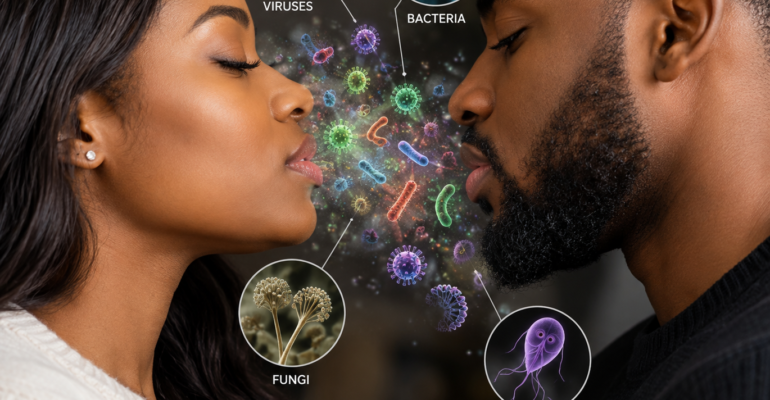
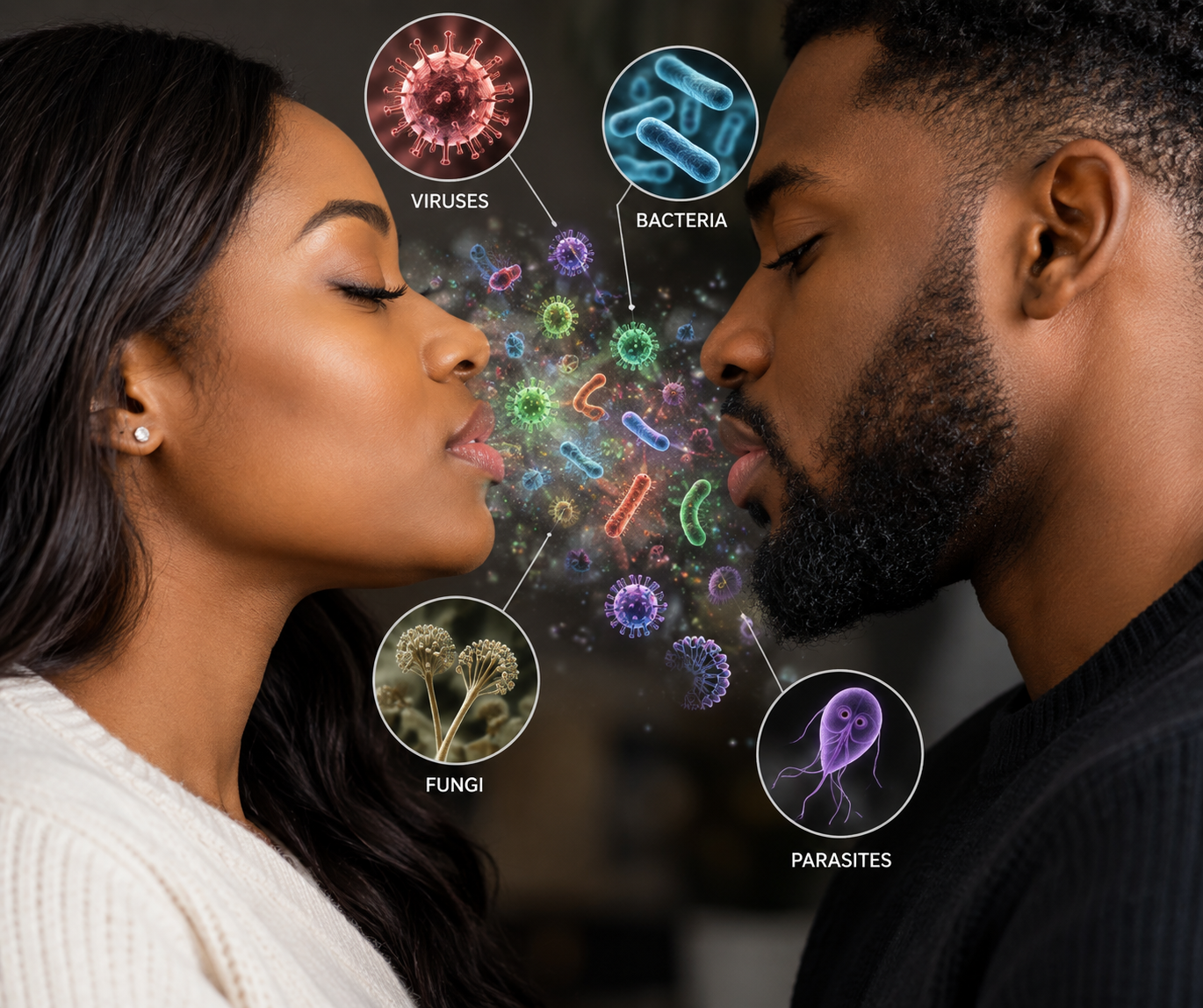
Infection is the invasion and multiplication of harmful microorganisms in the body, and it can be caused by bacteria, viruses, fungi, or parasites. All infections can be passed from one person to another through sexual contact that’s because sexuka contact involves all forms of contact (air, body to body contact, fluid exchange (saliva and sweat) and gential fluid exchange) allowing infectious organisms present in one partner to enter and affect the other partner.
Someone will say, I don’t kiss! No! The moment you talk, saliva spills out onto the other partner, simple. It takes just one drop of saliva for millions of microbes to transfer.
Pay close attention, married or single. There is a married version to this. There is’nt a single version to this.
Let’s go.
Sexual activity or activities is one that ensures there is both body contact and fluid contact dynamics. Either oral oo, vaginal oo, anal (yuck), abi, is it prolonged and sustained hugging without clothes? Any shape or form it takes, that body and fluid contact is involved.
Something invisible is actively at play without your knowledge or consent.
Hmmm, follow me.
THEY LIED ABOUT CONDOMS PREVENTING INFECTIONS
They lied when they say, oooh, condoms will prevent infections.
That lie made and has continued to make the condom industry explode. Do you see condom ads? No, a lie is driving the market: that it prevents infections.
Condom was initially designed to act as a contraceptive, designed primarily and for the sole purpose of preventing unplanned pregnancy.
People, seeing how well it prevents pregnancy, believe it also prevents microbes, Candida, parasites, and viruses from spreading.
Listen to the name: microbes.
It’s micro – microscopic.
The human, I mean man’s sperm, which it’s meant to block, is not microscopic. It’s very visible to the naked eye.
Hence, even though condoms will prevent conception, make no mistakes: it doesn’t prevent tiny microscopic infections from walking from one person to another.
During sexual activity, the fluid from the lady smears all over the man’s genitals, and his semen smears all over the lady. That fluid transfer is enough for microbes, which are invisible, to walk across each other and make the exchange between the two individuals.
Additional to this, if there is a shaving cut between the two partners, the rigorous activity can create micro-tears, giving microscopic microbes an opportunity to infect each other.
CANDIDA IS JUST ONE
Candida, for example, transfers via penetration, via skin-to-skin (I mean just your body rubs on another body) contact, and via sharing clothes. Like now, you wear the clothes of another person that’s infected.
If you think that’s all, just wait.
It transfers through breathing the air around the person. 😄 Someone will say, Maryann, you are exaggerating.
Oh, I wish.
I watched a documentary of a hospital where one person came in with severe Candida and others in the hospital got infected with it. Even after the person left, others got infected. People died because of it.
Because patients in the hospital already have weakened immunity, the Candida joined.
They cleaned and scrubbed everywhere. People who came weeks after still caught that same Candida infection.
Upon scrutiny, they realized the Candida had attached itself to the wall and was repopulating from there.
Air. Just air.
Candida is in the fungal family, and they send their spores out to colonize new territories, aka infect more people.
Candida is just one.
HERPES NKO?
You don’t even need to engage in sex to get these things.
Just a hug.That’s it.
These are just a few documented microbes that transfers during sex
Bacterial
1. Chlamydia — Chlamydia trachomatis
2. Gonorrhoea — Neisseria gonorrhoeae
3. Syphilis — Treponema pallidum
4. Chancroid — Haemophilus ducreyi
5. Lymphogranuloma venereum — C. trachomatis L1–L3
6. Donovanosis – Klebsiella granulomatis
7. Mycoplasma genitalium infection
8. Ureaplasma infection
9. Bacterial vaginosis-associated infections
10. Neisseria meningitidis infection
11. Shigella infection
12. Campylobacter infection
13. Escherichia coli enteric infection
14. Haemophilus influenzae infection
15. Streptococcus pneumoniae infection
Viral
16. HIV infection
17. Genital herpes — HSV-1
18. Genital herpes — HSV-
19. Human papillomavirus (HPV) infection
20. Hepatitis B
21. Hepatitis C
22. Hepatitis A
23. Cytomegalovirus (CMV)
24. Epstein-Barr virus (EBV)
25. Human T-cell lymphotropic virus type 1 (HTLV-1)
26. Mpox
27. Zika virus
28. Ebola virus
29. Marburg virus
Parasitic / fungal
30. Trichomoniasis — Trichomonas vaginalis
31. Pubic lice — Pthirus pubis
32. Scabies — Sarcoptes scabiei
33. Candida albicans infection
34. Candida glabrata infection
35. Candida tropicalis infection
36. Candida parapsilosis infection
37. Candida krusei infection
38. Entamoeba histolytica infection
39. Giardia duodenalis infection
40. Cryptosporidium infection
Parasites with documented sexual/intimate transmission
- Trichomonas vaginalis — trichomoniasis
- Pthirus pubis — pubic lice
- Sarcoptes scabiei — scabies
- Entamoeba histolytica — amoebiasis, including sexually transmitted fecal-oral transmission
- Giardia duodenalis — giardiasis, particularly through sexual practices involving fecal-oral exposure
- Cryptosporidium spp. — cryptosporidiosis, particularly through fecal-oral sexual exposure
MICROBES THAT CAN BE EXCHANGED THROUGH CLOSE PROXIMITY, KISSING, SALIVA, DROPLETS OR AIR DURING SEXUAL ACTIVITY
1. Helicobacter pylori (H. pylori)
2. Streptococcus pyogenes
3. Streptococcus pneumoniae
4. Mycoplasma pneumoniae
5. Chlamydia pneumoniae
6. Haemophilus influenzae
7. Moraxella catarrhalis
8. Neisseria meningitidis
9. Bordetella pertussis
10. Corynebacterium diphtheriae
11. Mycobacterium tuberculosis
12. Staphylococcus aureus
13. Klebsiella pneumoniae
14. Pseudomonas aeruginosa
15. Legionella pneumophila
16. Mycoplasma hominis
17. Ureaplasma urealyticum
18. Ureaplasma parvum
19. SARS-CoV-2
20. Influenza A virus
21. Influenza B virus
22. Respiratory syncytial virus (RSV)
23. Rhinovirus
24. Adenovirus
25. Human metapneumovirus
26. Human parainfluenza virus
27. Human coronavirus 229E
28. Human coronavirus NL63
29. Human coronavirus OC43
30. Human coronavirus HKU1
31. Measles virus
32. Mumps virus
33. Rubella virus
34. Varicella-zoster virus
35. Epstein–Barr virus (EBV)
36. Cytomegalovirus (CMV)
37. Parvovirus B19
38. Human bocavirus
39. Enterovirus
40. Parechovirus
41. Aspergillus species
42. Cryptococcus species
43. Histoplasma capsulatum
44. Coccidioides species
45. Pneumocystis jirovecii
46. Mucorales
47. Lassa virus
48. Ebola virus
49. Marburg virus
50. Mpox virus
TO BE CONTINUED IN PART 2